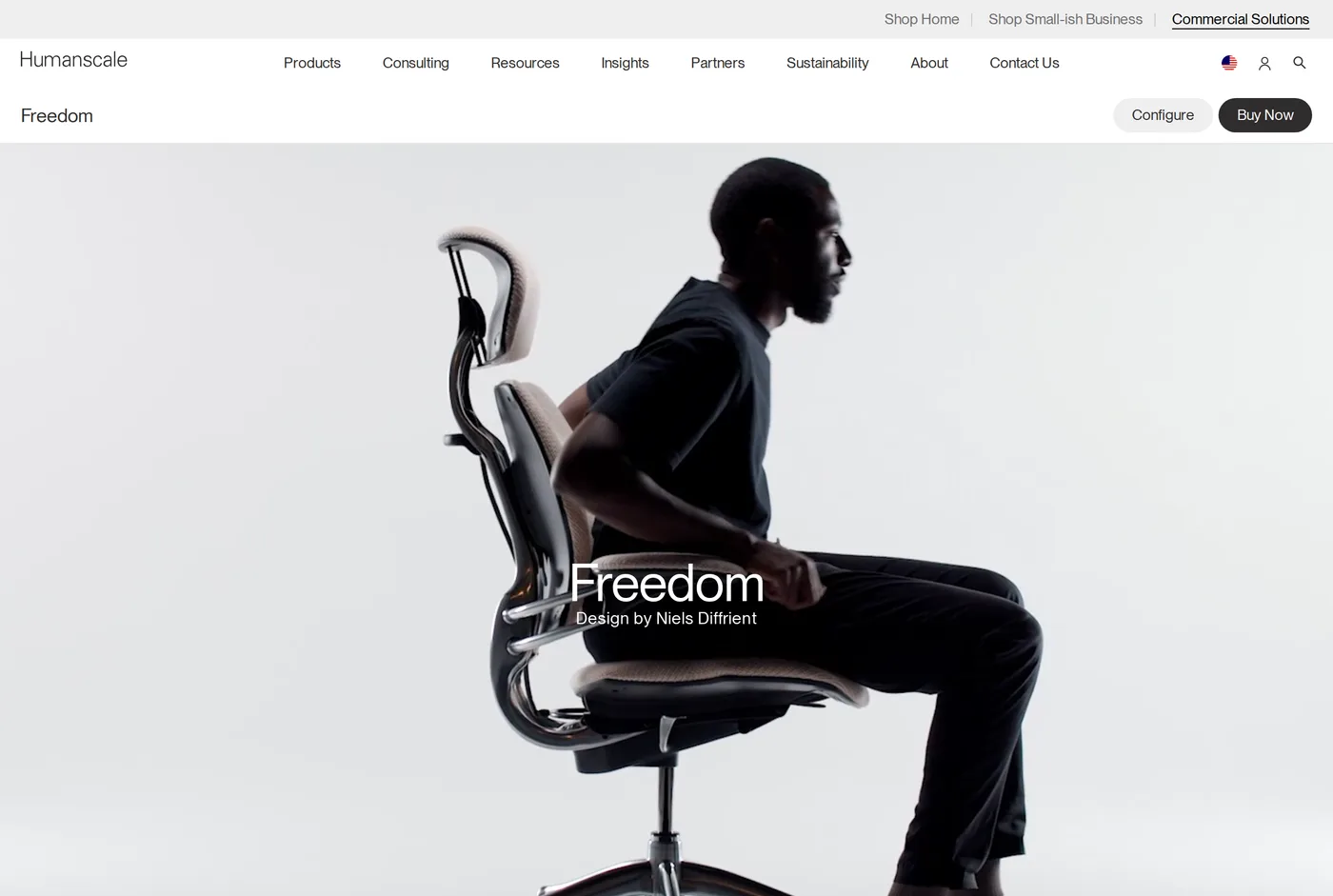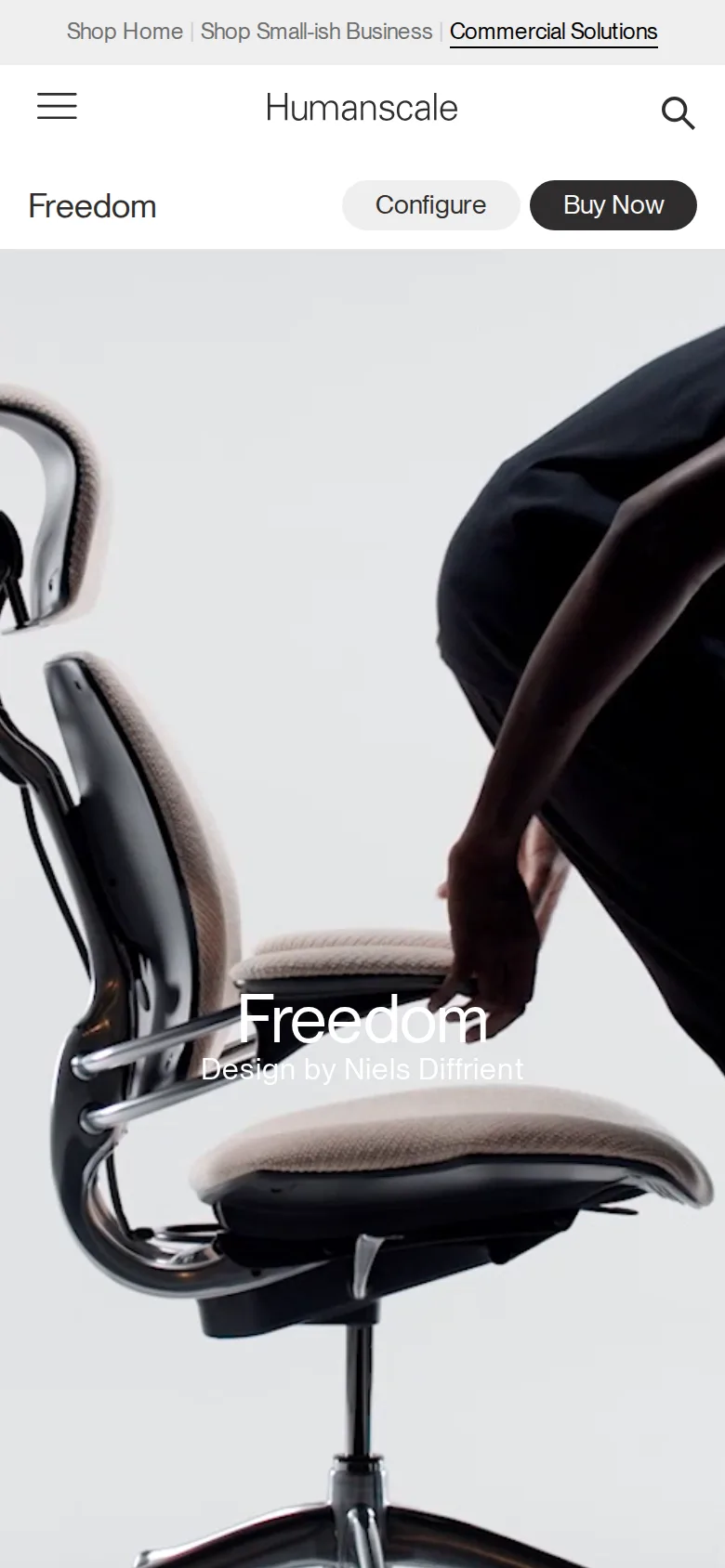
An argument, not just a chair
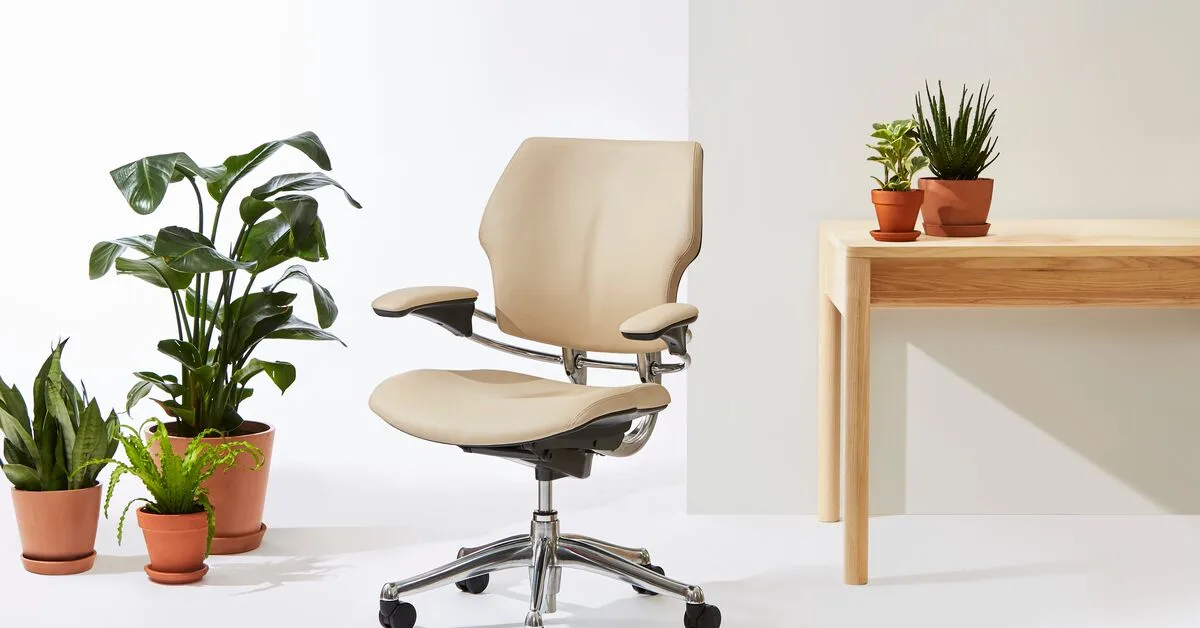
Humanscale's position is that adjustable chairs fail because people do not adjust them. Offices are full of expensive task chairs with the lumbar in the wrong place and the tension dial untouched since it left the factory. So the Freedom removes the controls and uses a counterbalance mechanism that recline-tensions itself according to your body weight.
It is a real argument and we have some sympathy with it. We have also sat in enough badly-set-up Leaps to know it is describing something true.
When it works
For a large middle band of bodies, it works beautifully. You sit down, you lean back, and the chair supports you at whatever angle you stop at without you having selected anything. There is no "locked in three positions" feeling — the recline is continuous and it stays where you leave it because your own weight is holding it there.
The headrest is the best we have used on a task chair, and that is not a low bar being cleared by default. It pivots as you recline, so it meets the back of your head at an appropriate angle at 100 degrees and at 125 degrees. Most headrests are set for one angle and become a neck-pusher at every other one.
When it does not
There is no tension adjustment. None. If you are at the light or heavy end of the range the mechanism was designed around, the recline will feel either too eager or too stiff, and there is nothing you can do about it. We tried. This is the single biggest risk in buying one unseen, and it is the reason we would insist on sitting in one first more strongly than for any other chair on this site.
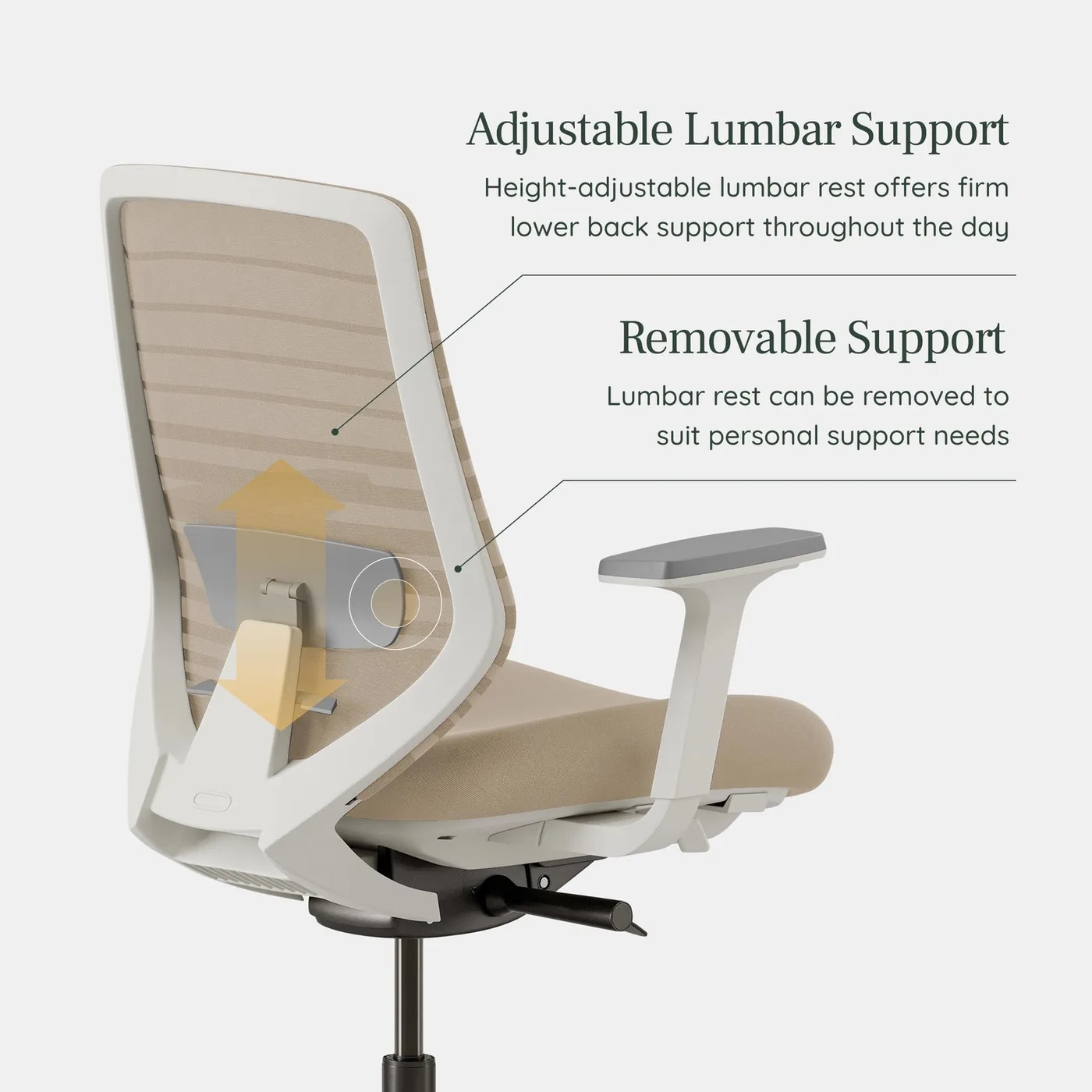
Lumbar support is gentle by design — the backrest's shape does the work rather than a pad. For people who want a firm, locatable push into the lower back, particularly after an injury, this chair does not have one and cannot be made to have one.
The armrests move up and down together on a shared bar. Independent height adjustment is standard at a quarter of this price. Humanscale's reasoning is that asymmetric arms are usually a symptom of a badly set-up desk, which is often true and occasionally irrelevant — some people genuinely need one arm lower.
What you do still adjust
"No controls" overstates it slightly, and the distinction matters.
Seat height is a conventional pneumatic lever. Seat depth adjusts. Arm height adjusts, on the shared bar. The headrest position adjusts. What is absent is the recline tension dial, the back-angle lock and the separate lumbar control that other chairs in this bracket give you.
Humanscale's argument is that those three are exactly the controls people set wrong and then leave wrong, and there is something to it — we have sat in plenty of expensive chairs with the tension at the factory setting and the lumbar at the bottom of its travel.
The counter-argument is that a control set wrong can be set right, and a control that does not exist cannot.
Build and looks
It is beautiful. That is not normally a point we would spend a paragraph on, but if the chair lives in a corner of a living room rather than a dedicated office, it matters, and the Freedom is the only chair in this group we would happily have in a room people see. The leather and textile options are properly finished and the aluminium is not pretending to be something else.
Build quality matches the price. Over a long test we found no rattles, no creak from the recline, and no sag in the seat foam.
Value
This is where it loses points. Measured purely in adjustments-per-pound, the Freedom is poor value: a Leap costs less and adjusts in roughly four more dimensions. Measured in "how good is it when it fits you", it is competitive with anything here.
That makes the buying advice unusually blunt. Sit in it. If it fits, it is a lovely chair and the lack of controls will stop being a specification and start being a relief. If it does not fit, buy a Leap and adjust your way to comfort, because the Freedom will not meet you halfway.
What holds up
- Weight-sensitive recline needs no tension dial and gets it right for most people
- The headrest pivots with the recline — the best headrest implementation we have used
- Genuinely elegant; the only chair here we would put in a living room
- Very few controls means very few ways to set it up badly
What wears thin
- No recline tension adjustment at all — if the mechanism does not suit your weight, you are stuck
- Lumbar support is gentle; people who need a firm push will not find one
- Arms move together on a single bar, not independently
- Expensive for the number of adjustments you get