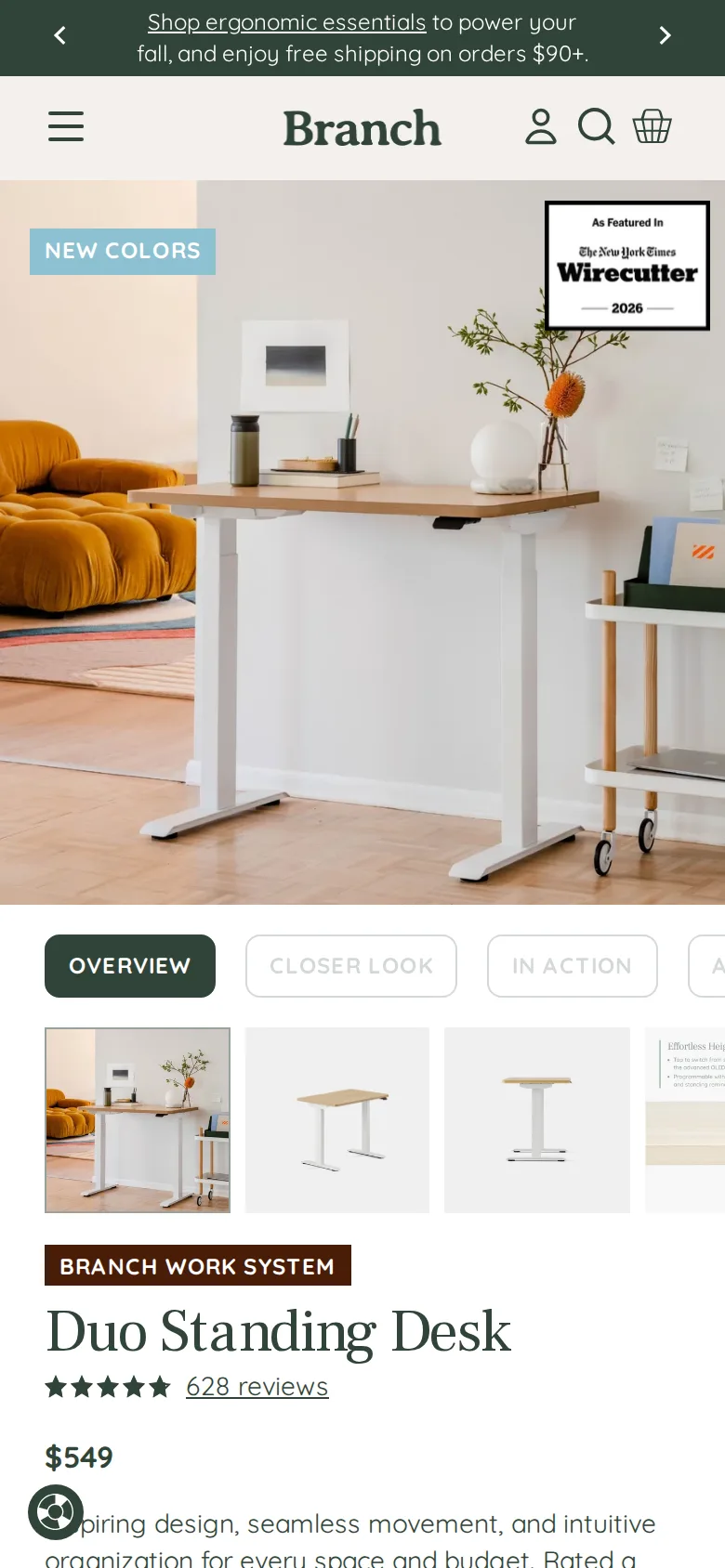
Nearly every standing desk is designed at about 60 × 30 and then shrunk. You can tell, because the small versions use the same crossbar geometry with the legs closer together, which is the arrangement that flexes most. Branch designed the small Duo as a small desk, and in a category full of 1.5-metre slabs aimed at people with a spare room, that is the most useful thing about it.
The 36-inch case
Thirty-six inches by twenty-four is roughly a metre by sixty centimetres. It fits in an alcove, at the end of a bedroom, in the corner of a living room that has to be a living room again at six o'clock. It holds a laptop and a 27" monitor on an arm with room for a notebook, and it does not dominate the room.
At that size the Duo is stiff. Pushing the front edge at standing height produces a small, quickly-damped movement, and typing does not shake the monitor. The legs are close enough together that the structure works with rather than against itself.
If your room can take a bigger desk, take a bigger desk — more surface is always better. But if it cannot, this is the one that does not feel like a compromise.
The 58-inch case is weaker
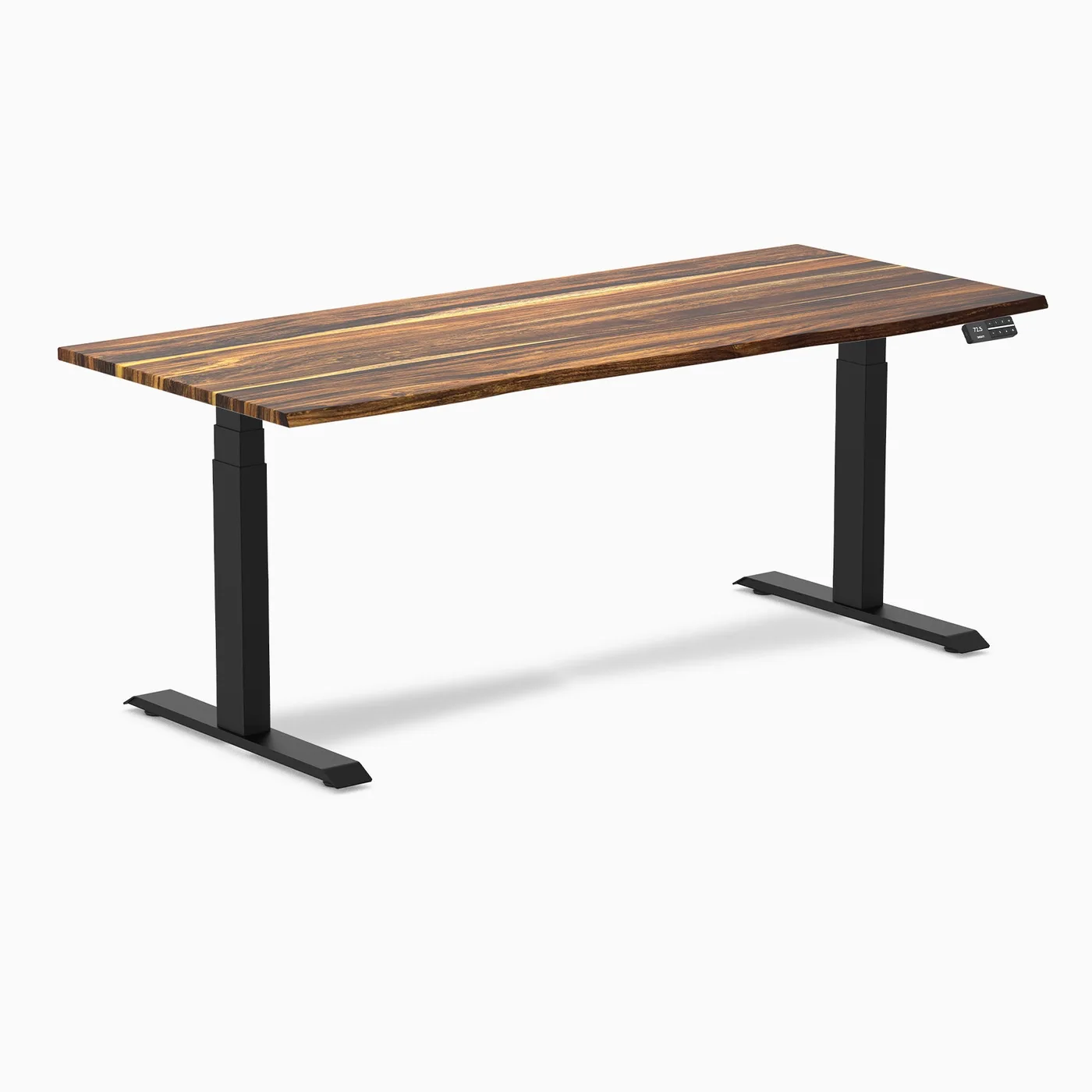
The same desk at 58 × 27 is a different experience. It is fine; it is not special. At that size you are competing with Uplift, Desky and Fully-derived frames that have more metal in them and cost about the same or less, and the Duo flexes more than any of them at full height.
Our advice is unusually specific: buy the Duo at 36 × 24, consider it at 48 × 24, and look elsewhere at 58 × 27.
Living with it
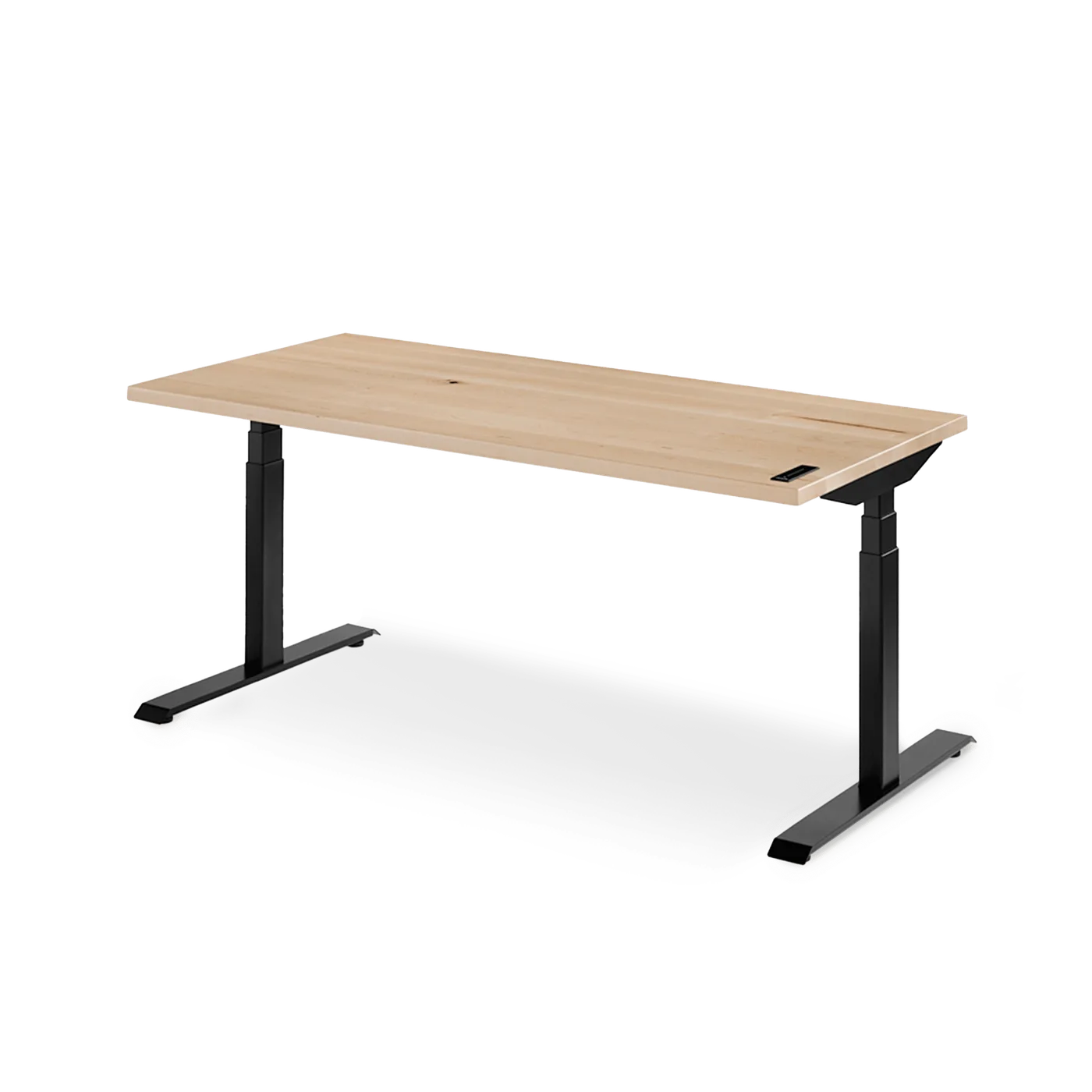
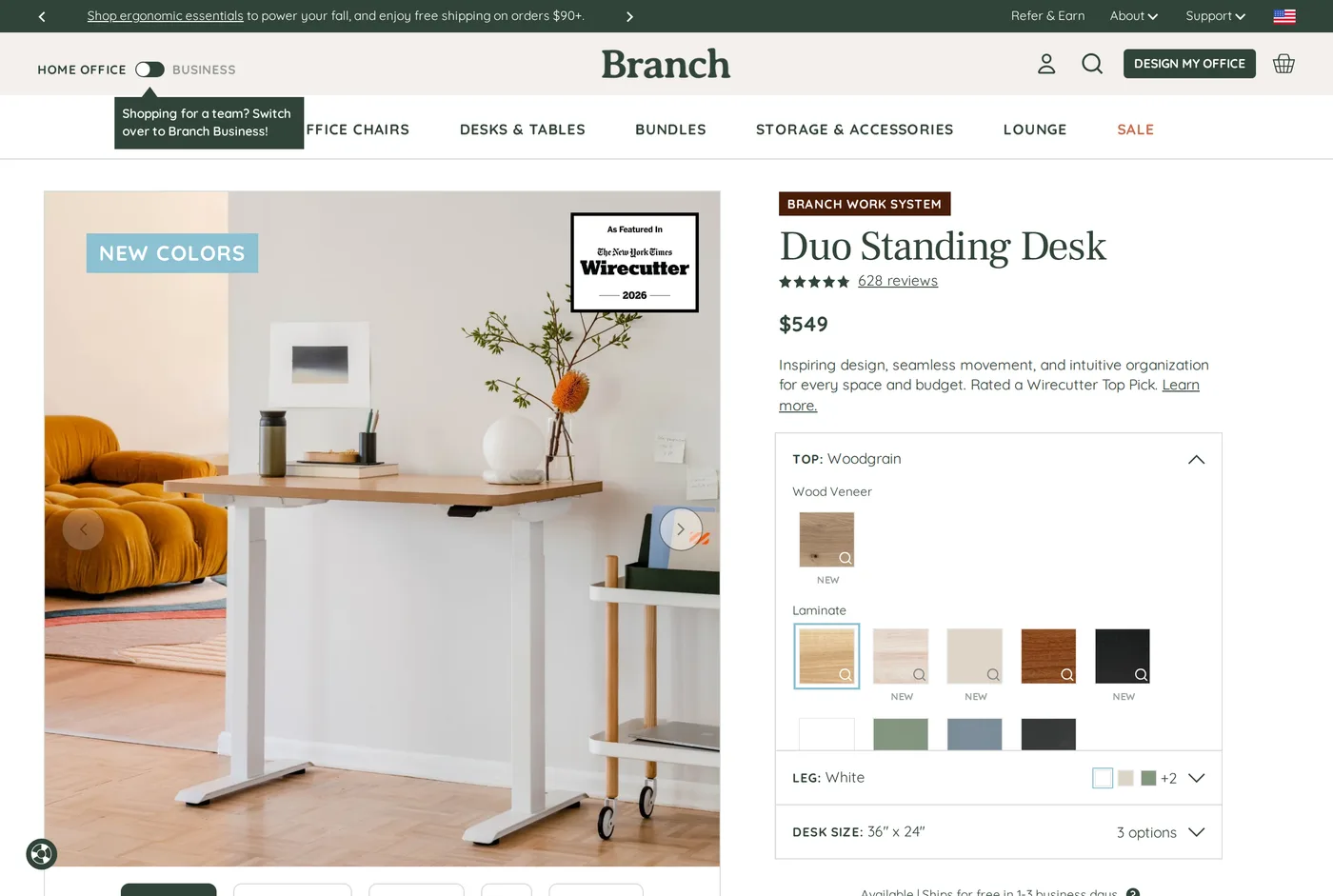
Branch's finishes are the other half of the appeal. The wood veneer and laminate options are chosen to look like furniture rather than office equipment, which matters enormously if the desk lives somewhere people also relax. A grey office desk in a bedroom always looks like a grey office desk in a bedroom.
Shipping is free and quoted in one to three business days. In a category where a fortnight is normal and five weeks is not unusual, that is worth something.
Assembly took us about forty minutes with two people. Clear instructions, everything labelled, no surprises. The top attaches with machine screws into inserts, so it will survive being taken apart.
Measured, at the small size
On the 36 × 24 configuration, with a 27-inch monitor on an arm clamped at the back edge:
Sitting height to the top of the surface: about 65 cm. Standing: about 128 cm.
Transition, bottom to top: roughly eighteen seconds.
Lateral deflection at the front edge at standing height under a firm push: around 5 mm, settling almost immediately.
That deflection figure is better than the Uplift's, which is not a criticism of the Uplift — it is what a shorter span does for you. It is also why we are lukewarm on the 58-inch version of the same desk, where the advantage disappears.
In a bedroom, specifically
Two things we did not expect.
The desk is quiet enough at night that raising it did not wake someone asleep in the same room. We would not describe any electric desk as silent, and this one is in the group that will not start an argument.
And the finish matters more than we assumed. We had the wood veneer, and against a white wall in a bedroom it reads as a small table rather than as office equipment. That is the whole reason to pay Branch's prices rather than buying a frame and a laminate top, and it is not a thing a specification sheet can convey.
The add-on tax
Branch runs an accessory ecosystem alongside the desk, and it is a mixed picture.
The good part: things clamp or hook to the frame rather than requiring you to drill the surface, and they are properly finished.
The irritating part: a Bluetooth adapter to control the desk from a phone is a $19 extra, and the desk drawer is $99. Neither is outrageous on its own. Together with a cable organiser and the rest of the recommended list, a $549 desk becomes a $750 desk without anything being added to the frame.
Our view: skip the Bluetooth adapter — the physical controller is better anyway — and buy the drawer only if you have nowhere else to put a notebook.
Verdict
Eight point two, earned almost entirely by the small size. If Branch sold only the 36 × 24 and nothing else, this would score higher, because the large version drags a specialist product towards the middle of a crowded field.
For a small room, we do not know of a better answer.
What holds up
- A properly engineered 36 × 24 — most small desks are cut-down large ones
- Finish options that look like furniture rather than office equipment
- Ships free in one to three business days, which is unusual in this category
- Sensible accessories that attach without drilling the top
What wears thin
- The 58 × 27 flexes more than a comparably priced full-size frame
- Bluetooth adapter is a $19 add-on for a feature others include
- A $99 desk drawer is a lot for a drawer
- Only one leg colour per top finish in some combinations